
Intelligent guidance: designing for technological humility
Enterprise IVR-to-digital redirection pattern for a top-5 US bank
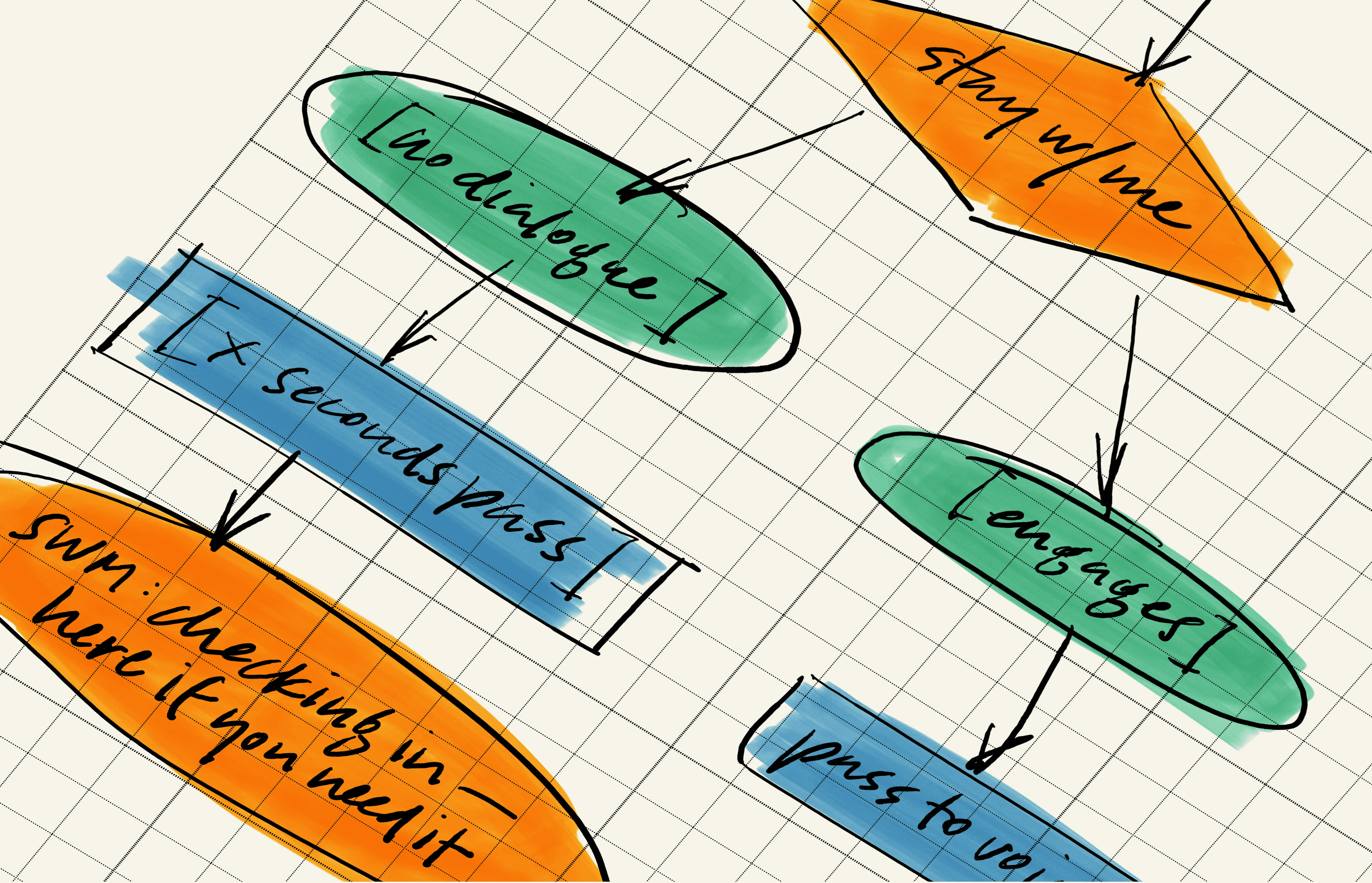
the short version: I was designing IVR-to-digital redirection flows for a bank and the original design assumed the NLU could perfectly classify customer intent. It couldn't. Instead of fighting that limitation, I redesigned around it — creating a single adaptive flow that bundles both general knowledge and personalized information, then lets the customer choose how to proceed. The multi-modal handoff respects user agency at every transition. What started as one use case became repeatable infrastructure that other teams could stand up without starting from scratch.
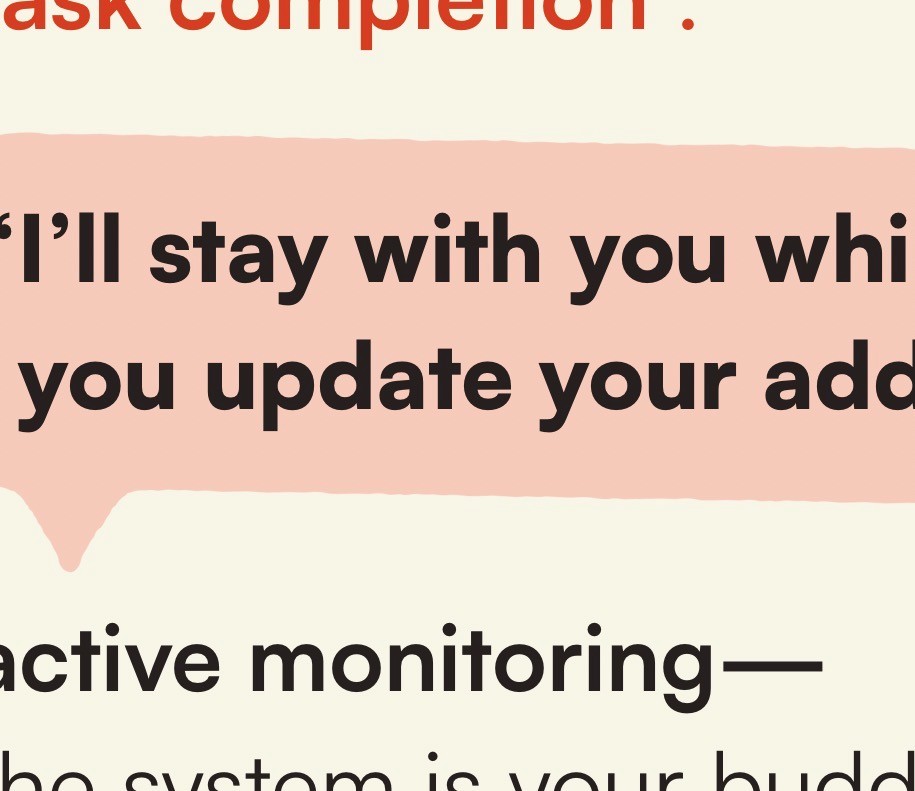
the “stay with me” pattern
The multi-modal transition — voice to SMS to web — is where most systems fumble. You're asking someone to leave the channel they chose (the phone) for a channel you're suggesting (their phone's browser). That only works if every transition respects their agency.
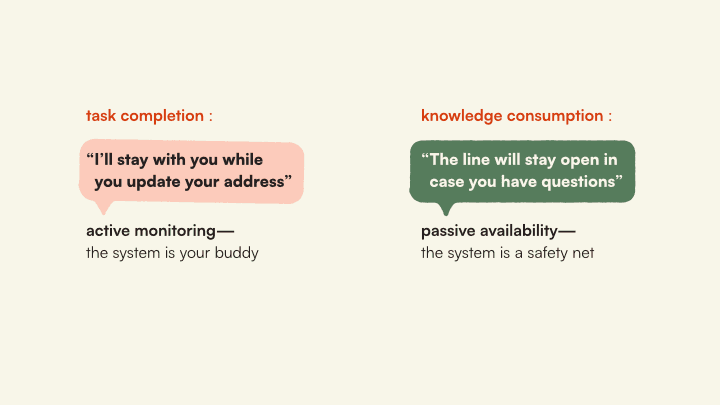
So we designed what we called the “Stay With Me” experience. And it turns out, the right language depends on what the customer is doing.
For task completion — like updating an address — the IVR says: “I’ll stay with you while you update your address.” Active monitoring. The system is your buddy.
For knowledge consumption — like reading a policy article — the IVR says: “The line will stay open in case you have questions.” Passive availability. The system is a safety net, not a supervisor.
That distinction matters. Reading an article while someone watches you feels weird. Reading an article knowing help is a sentence away feels supportive. Same technology, completely different emotional experience.
And crucially: “If you have everything you need, you’re welcome to hang up.” Always an exit. Never a trap.
the scorecards
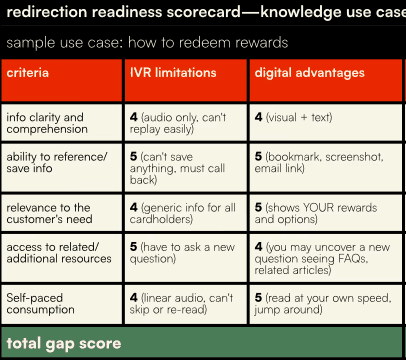
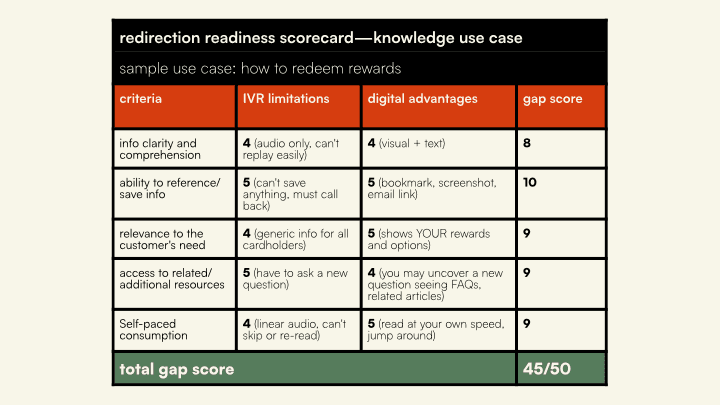
To figure out which use cases were ready for digital redirection, I developed Redirection Readiness Scorecards — a quantifiable framework that any team could use to evaluate whether a particular task was a good candidate.
We scored each potential use case across multiple dimensions: task complexity, digital experience quality, authentication requirements, user digital engagement history. Address change scored 41/50. Rewards scored 45/50. The scores gave us a shared language for prioritization and made the decision-making process transparent instead of opinion-driven.
More importantly, they made the framework replicable. Any line of business could evaluate candidates for redirection without waiting on a centralized conversational AI team.
the outcome
The pattern shipped and is now the default way this bank handles IVR-to-digital handoff for similar use cases.
One adaptive flow instead of complex NLU-dependent branches. SMS with two links — knowledge article plus personal account action — instead of forcing a single path. “Stay With Me” language that offers support without forcing it, calibrated to the type of task. Playbooks and evaluation frameworks so other lines of business can stand up their own Intelligent Guidance systems without starting from scratch.
As a consultant, I don't own the long-term metrics. but i do know this: the framework shipped, it's live, and it's scaling. No mean feat for an enterprise like this one.
the real lesson
Sometimes the most elegant solution is to stop trying to be perfect and start being helpful. We turned a technological limitation into a design improvement. By accepting what the NLU couldn't do, we created an experience that was simpler to build, easier to maintain, and more respectful of the humans on the other end of the line.
Every design choice is a values statement. Routing a customer to the right channel isn't a cost optimization play — it's an act of respecting their time and their agency. The technology should serve that, not the other way around.